
The bribery detector
One detective was employed to unearth bribery in Victorian elections

In 1869, one private detective set up a private inquiry office that specialised in election work. Established by a man named William Henry Bailey - although he admitted that “he did not always take the same name” - he was working for at least five years in this role.*
Bailey didn’t just undertake monitoring work during elections - he did do the usual work of detectives as well. Divorce cases, watching people’s houses and spouses were all part of his job, but it was for his election work that he gained some notoriety. He had first studied the voters and candidates in Southampton during the 1862 election, before setting up his agency. He was not averse to using bribery himself, for when he managed to get access to people’s houses during jobs, he might pay their servants to give him information.
In 1874, Bailey was employed by Messrs Cooke & Talbot - a firm of London solicitors (not the Southport company of a similar name, which still exists today) - to do some work in Kidderminster during the election. He travelled to Birmingham to meet a man named Richard Powell - who was known, ominously, as ‘Slinky Dick’. Powell gave him instructions and a Stourbridge & Kidderminster Bank cheque book - I believe that his role was to encourage Bailey to help bribe individuals, and that Powell did not know that Bailey was a private detective.
Bailey travelled to Kidderminster, where he claimed to be a representative of the Reform Club, and visited various local pubs. Here, he went to known Conservative supporters among the publicans, trying to obtain their ‘accounts against Mr Grant’ - the election’s Conservative candidate, Dublin-born Albert Grant (born Abraham Gottheimer, but he changed his name before marrying in 1856). Bailey gave the line, “We are anxious that Mr Grant’s agent should be able to swear he had not paid the accounts”. Bailey had lied to get information, and was later told off for using “these tricks and devices”. Albert Grant was duly voted in at the election, winning by 111 votes.
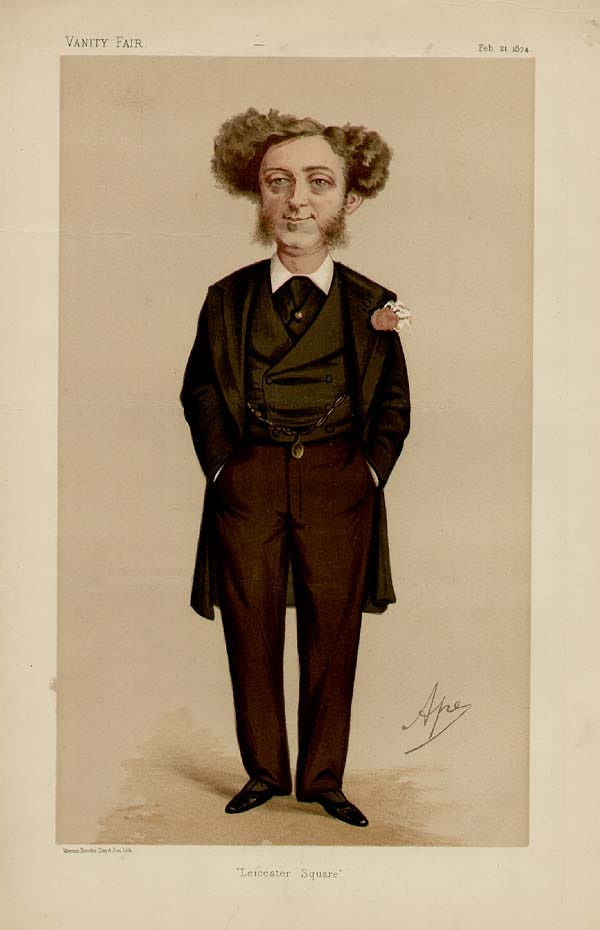
Albert Grant, from an illustration in Vanity Fair from 1874
#/media/File:Albert_Grant_Vanity_Fair_21_February_1874.jpg)
A petition was soon submitted to the Court of Common Please, complaining that the election result was corrupt. It was found that Albert Grant’s election and return were ‘null and void’ and that Grant was guilty of corruption. He, and his agents, had bribed the voters and Kidderminster residents with ‘an entertainment, consisting, among other things, of meat and drink’ in order to persuade people to vote for him. His declared expenses were £300, but he had actually spent four times that amount. It was a successful strategy in the sense that Grant was duly elected - but his methods were not above board.
Bailey had been employed to find evidence of Grant’s bribery, and claimed to have done so, but when he appeared in court to give evidence, the judge gave him short shrift because of his identity as a private detective. He even bemoaned the growing trend of people employing private detectives to uncover bribery, because of their reputation for lies and shady behaviour.
Yet it is clear that there were bribes being made at elections, and someone had to sniff them out. Why not private detectives such as Mr Bailey?
* I assume that this Bailey was the Yorkshireman William Henry Bailey, born in 1835, who I have previously researched. He had previously been a debt collector, and would later become an auctioneer before dying in 1888, aged 53