
From divorce to death
One Scottish detective was involved in divorce cases - and an infamous murder

Private detectives took on work in various fields: although divorce cases and chasing debtors or serving papers occupied most of their time, some dreamed of solving bigger cases, believing that their skills were better than those of the police.
In 1886, Mary Flynn sued her husband Francis for divorce on the grounds of infidelity. The case saw Francis Flynn retaliate by accusing Mary of depriving him of his property through false pretences.
Mary had been born in 1841 in Glasgow; her husband was English by birth, and the same age as her. The couple had married in September 1860, and between 1862 and 1882, had 12 children, only one of whom died young. In 1881, Flynn was working as a spirit merchant, but by 1886, was said to be an iron dresser. With eleven surviving children, times were hard, and things must have been difficult. The couple split up, and started living separately.
However, Francis Flynn did not take up lodgings on his own - he moved into lodgings with one Mrs Cunningham. Mary decided to seek a divorce, but for this, she needed evidence of her husband’s infidelity. She therefore chose to employ a private detective named John Maxwell Calton.
Calton was born in Cape Town in 1842, the son of a Scottish engineer. Although he and his siblings were all born in South Africa, the family had returned home by 1851, migrating back to his father Robert’s hometown of Wigtown.
In 1868, John married his wife Henrietta in Dublin in 1868 - Henrietta was from Rathmines in the city. On his marriage, he was listed as being from Glasgow. John was, at this time, working as a detective inspector for the Glasgow City Police. He and Henrietta would go onto have seven children.
The 1881 census shows him staying with the Clanachan family in Wigtownshire, and he was referred to as a private detective in a Glasgow newspaper at around the same time. This may have been his second spell as a private detective, however, for an article in the Glasgow Herald in February 1881 had noted that he had formerly been a private detective in the city, but was now working as a bootmaker. Yet an article a month later, and the census in April, both referred to him again as a private detective.
It is clear that Calton was viewed with a bit of suspicion locally - at least by the press. In late 1880, he had gone to Wigtownshire to try and solve a local murder - known as the Glenluce murder. There had been two infamous murders this year in Glenluce: the first, in April, involved the murder of a 16-year-old boy one evening, after a night drinking with his friends - one of whom would go on to kill him.
But two months later, James Milligan and his housekeeper, Miss Macreadie, were also attacked, in a case that was not as simple to solve. Milligan was killed, and Macreadie was seriously injured, dying soon after. No immediate clues as to the murderer were found, and the government offered a reward of £100 for his apprehension. It was believed that the perpetrator must have had a good knowledge of the local area, and knew where Milligan, an elderly man, kept his money in his house. A strange man was seen soon after in the village of Carronbridge, washing blood from his clothes and accompanied by a woman in a bonnet, but neither could be identified.
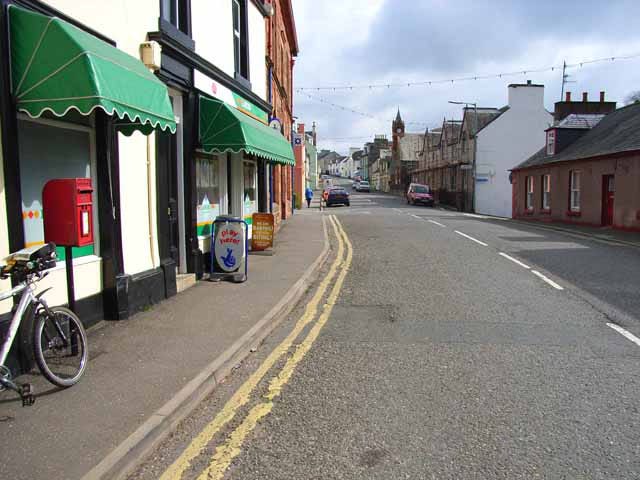
The village of Glenluce (photograph by Oliver Dixon and used under creative commons)

The police worked tirelessly on the case, being described as ‘exhausted and disappointed...nigh on the borders of despair’ after arresting numerous people and having to release them (Paisley Daily Express, 17 June 1880). John Maxwell Calton saw the criticism of them, and their failure to apprehend a suspect. He got in touch with the police, saying that he would return to private detective work and try to solve the Glenluce murder if the police paid his expenses. They agreed. He would spend a couple of months in the area, and presumably this is why the 1881 census has him lodging in the historic county of Wigtownshire, rather than being at home with his family.
On failing to solve the case, one individual wrote to the Glasgow Herald to say that his ‘inquiries were simply a repetition of those made by the police’, but that he had made the mistake of ‘getting at loggerheads’ with the police detectives. The letter writer then added:
‘It is very evidence he is more at home at his own business than dabbling in the difficulties of a mysterious murder.’
Eleven years later, with the murderer still at large, James Milligan’s watch was found in a turf dyke in Auchtralure, Stranraer, by a local labourer. The case was never solved.
In 1886, six years after James Milligan’s murder, Calton was still a private detective, and as such, was commissioned by Mary Flynn to investigate her errant husband. Calton accompanied Mrs Flynn to Great Eastern Road, where they spied through broken windows at Mrs Cunningham’s lodgings. They also visited an old, drunken Irishwoman named Mrs Ford, who told the detective that she had seen both Francis Flynn and Mrs Cunningham in bed at her house. Mr Flynn would later accuse Mary of having paid Mrs Ford five shillings, and given her alcohol, in order for her to say this - but Mrs Ford insisted that he was lying.
John Maxwell Calton continued to gather evidence after this instance, shadowing both parties and seeing them together both at Great Eastern Road and Green Street. His evidence was believed in court, and Mary Flynn gained her divorce. Neither parent would look after their children after their divorce, with the older siblings instead looking after their younger ones alone.
After this case, Calton continued in his line of work. Between 1886 and 1889, he advertised his services in the local papers. One advert, placed shortly after the Flynn case, stated:
PRIVATE DETECTIVE (ex-police). 19 years’ experience; Watching, Tracing, Divorce Cases a speciality. Mr Calton, 118 Florence Street, Glasgow.
By 1889, Calton had moved his work premises from Florence Street to Hope Street.
The 1891 census shows him living in Govan with his wife and children. By 1901, however, he was boarding with a drapery traveller named Hugh Miller - together with Miller’s family. Henrietta was not with him, but instead living on another Govan road with three of their sons. Calton was working as a private detective and collector - presumably collecting debts, as many of Glasgow’s private detectives did.
John Maxwell Calton died, aged 69, in 1911, at Garngad Hill (now part of Roystonhill in North Glasgow). His career had involved both police and private detective work, and he had run the gamut from divorce cases and debt collecting to murder investigation work.